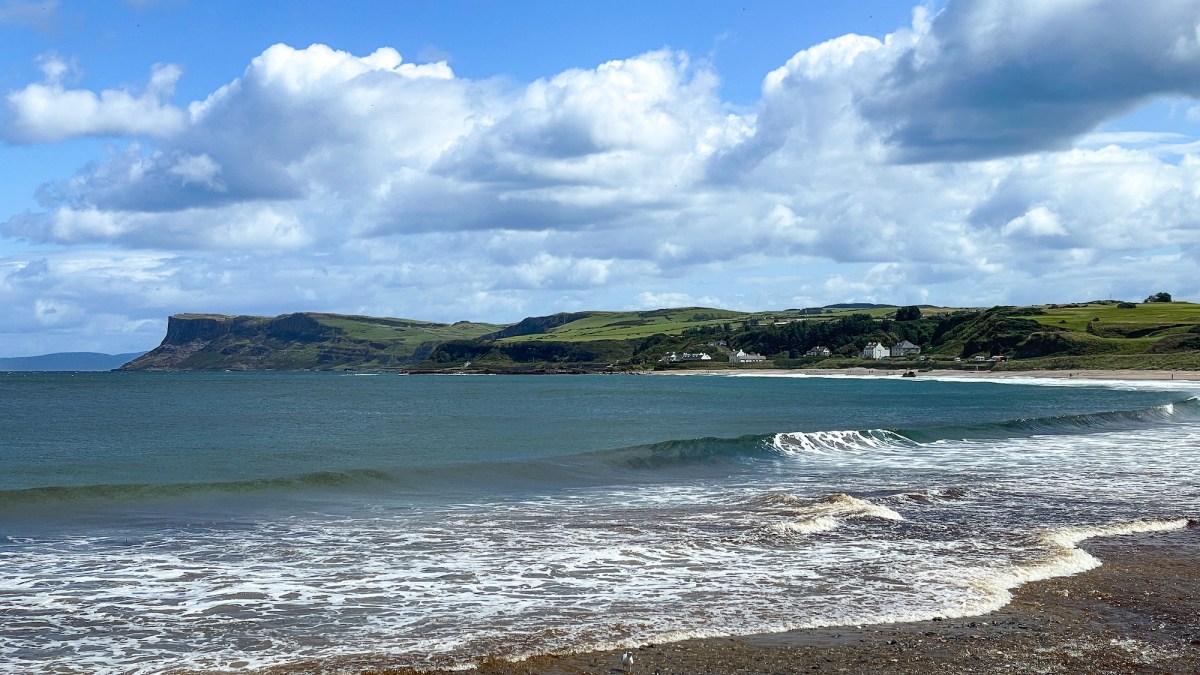
From Dublin to Belfast, via Connemara and Galway, the dizzying height of the cliffs at Slieve League and the legendary Giant’s Causeway, Ireland is an island full of contrasts. We were captivated by its rich cultural heritage, its wild landscapes, and the friendly curiosity of the Irish.
Introduction
A narrow road runs through the countryside, winding its way between stone walls and green pastures. A few sheep scattered about the scenery are the quiet rulers of the land. Everywhere around us, the wild beauty of our surroundings is striking – towering cliffs, storm-battered coastlines, white sandy beaches, lakes gleaming with silver, and windswept peatlands blanketed with heather. The ever-changing light glimmers between thick mist and fleeting golden flashes. Sheltered from wind and waves in a peaceful fishing harbor, and handful of fishing boats bob softly on the water by a row of colorful houses. Remnants of the past are dotted throughout the landscape: a castle in ruins, an abbey swathed in ivy, a manor from a bygone era, a Celtic cross raised against the sky.


Further on, a bustling city combines Georgian elegance and modern architecture. Brimming pints click together in the burnished wood interior of a cozy pub. A lively melody is played on a fiddle. A tin whistle joins in. Patrons’ hands clap in time. This is the vibrant heart of the Irish soul. The people are much like their country – honest, a little gruff at times, but happy to share stories and traditions as soon there is a connection. Those we meet leave a lasting impression – natural hospitality, straightforward, but sincere. The Emerald Isle is a land filled with contrasts and emotion.


Here are some of our favorite discoveries, memorable experiences and must-see spots in Ireland.
Our favorite discoveries
Dublin
• Trinity College
Trinity College is Ireland’s oldest university, with Oscar Wilde and Samuel Beckett among its alumni. The university was founded 1592, and is comprised of numerous grand stone buildings, such as the one that houses the Old Library and the Long Room.

Built between 1712 and 1732, this majestic library is 63.7 meters long, 12.2 meters wide, and et 14.2 meters high. The room is permeated with the scent of old books, which emphasizes the fact that this temple of knowledge is steeped in centuries of history.


The Notre-Dame fire served as a wake-up call to restore this piece of cultural heritage by installing a state-of-the-art fire protection system. The renovation is set to take several years, and a large portion of the over 200 000 volumes has been removed. In its place, an enormous globe has been suspended from the library’s oak ceiling. Luke Jerram’s famous Gaia installation uses NASA’s 3D images of Earth, taken from space. The effect is striking.


One of Trinity College’s (and all of Ireland’s) greatest treasures is the Book of Kells, an incredibly well-preserved Bible manuscript containing illuminations of the four Gospels of the New Testament, dating back to the 8th, 9th and 10th centuries.
• St. Patrick’s Cathedral
Built in the 13th century in honor of the patron saint of Ireland, Saint Patrick’s Cathedral is the country’s largest church. It is also the seat of the Church of Ireland, which is part of the Anglican Communion.


• Temple Bar
Temple Bar is one of Dublin’s liveliest areas. Explore Fleet Street in the late afternoon to take in the festive atmosphere and jaunty live music streaming from the many bars and pubs. The Temple Bar is one such iconic pub.


We wander away from the bustle and buzz of Temple Bar to take a closer look at Ha’penny Bridge, one of the capital’s most famous landmarks. This cast iron pedestrian bridge is the oldest footbridge across the river Liffey. It was named after the historical rate that was once asked to cross it – a half-penny.

South Connemara
Herds of cows, sheep and Connemara ponies graze on the verdant peatlands dotted with blooming heather.

Along a coastal road, little coves, white sandy beaches and sheltered little fishing harbors appear in rapid succession.


Fluffy clouds float along in the sky, pushed by the wind, and the sunlight is reflected in tranquil lakes. In the distance, the rounded peaks of the Twelve Bens of Connemara rise up in the mist.


Galway
Being the gateway to Connemara, Galway is a bustling city with a young and relaxed atmosphere. Don’t miss the city center, the Latin Quarter and Quay street in particular.


Our recommendation: Enjoy the view of the Long Walk, a street of colorful houses right on the Galway Bay, from the Eglinton Canal Sea Lock.


Connemara
• Lough Corrib
Ireland’s largest lake (3 112 km2) is scattered with dozens of wooded islets. All over the undulating landscape along the banks is a crisscross pattern of low stone walls between the fields, where horses and sheep graze serenely.


• Hike around Diamond Hill
At Letterfrack, hikers around Diamond Hill are rewarded with a breathtaking panorama. There are three possible difficulty levels for the hike: yellow is easy, for an itinerary taking about 30 minutes, blue is a medium loop of around an hour, and red is difficult, for those who want to climb all the way to the top of Diamon Hill. The paths are wide and well maintained.


• Killary Fjord
Killary Fjord is Ireland’s only fjord. This calm sound is full of nets for mussel farming.


Far up on the hillsides, traces of old potato fields, decimated by a type of mold called potato blight during the Great famine (1845-1850), are still visible.

• Kylemore Abbey
Kylemore is one of the most iconic landmarks in Connemara. This Victorian mansion, which was built in 1868, has functioned as a monastery for a community of Benedictine nuns since 1920. As a lover of all things Victorian, Stéphanie particularly enjoyed the architecture of the abbey.


In addition to the interior of the building, the tour of the vast property also includes the stunning Victorian walled garden, and a quaint little gardener’s house.
• Doo Lough
In this wild and craggy landscape, there is every shade of green imaginable all around you.

The lake is surrounded by steep, windswept mountains, where the sheep grazing on the slopes and hillsides are often mistaken for rocks, and vice versa.

The sea cliffs of Slieve League
The cliffs at Slieve League are among the tallest Europe (around 600 meters). A marked path and well-maintained lookout area allow visitors to fully enjoy the incredible panorama. The view of the steep cliffs jutting vertically out of the ocean is spectacular. You can really feel the force of the Atlantic, as it crashes against the rocks with a deep, muffled boom.


The ocean simmers and seethes in shades of deep teal around two rocks, known as the Giant’s Desk and Chair.
During our visit, the heather danced on the plateau with every gust of wind, and the hazy clouds gave the place a mystical aura.

This extraordinary natural site was one of Jérôme‘s favorite discoveries in Ireland.
Derry, Northern Ireland
The murals all around the Catholic neighborhood of Bogside recount the main events of the Troubles (the conflict in Northern Ireland), such as Bloody Sunday (1972).


One of the best ways to see Derry is by walking along the 17th-century city walls from Bishop’s gate, passing by St. Columb’s Cathedral.


Stéphanie particularly enjoyed the Victorian red brick façade of Derry Guildhall (the town hall, built in 1890).

The inside of the building is worth visiting, most notably for its stunning stained-glass windows, and the massive pipe organ in the Main Hall upstairs.


The Peace Bridge, which was inaugurated in 2011, connects a Protestant unionist neighborhood to a Catholic nationalist area.

This pedestrian bridge, winding its way across the river Foyle, is a recent symbol of reconciliation i Derry. Crossing over to Ebrington Square also gives visitors a stunning view of the city center.


The landscapes along the Causeway coastal route
From the parking lot at Portaneevy, the views of the rope bridge to Carrick-a-Rede (to the east) and the cliffs of the Causeway costal route (to the west) are remarkable.


The wild landscapes along the coastal road are among the most striking in all of Northern Ireland.


Giant’s Causeway
The Giant’s Causeway is a collection of well over 20 000 column-like basalt formations. These are a result of a lava flow cooling to volcanic rock, which has then cracked and subsequently been eroded into a geometric pattern. Beyond its singularity as a geological site, the Causeway is steeped in myths and legends.


This incredible landmark, which has been a UNESCO World Heritage site since 1986, is very much worth protecting.

The Giant’s Causeway was an unforgettable experience and a firm favorite for both of us. More to come on this subject, so stay tuned!.

Belfast
• The distinctive feature of Queen’s University Belfast, which was built in 1849, is its architecture. The style of the buildings is inspired by Gothic and Tudor elements from famous universities all over the British Isles.

• In the heart of the Titanic Quarter, named after the famous ship, which was built in Belfast, the striking building of the Titanic Experience is the same height as the hull of the Titanic. The museum offers visitors a deep dive into the history of the ocean liner.


• The murals adorning the walls throughout Catholic and Protestant areas, as well as the high metal gates separating the neighborhoods, are what remains of the Troublesthat divided the city as well as the whole country, for three decades. Even though the situation has calmed down significantly, the tension is palpable even to this day.


Practical information
Traffic
Ireland and Northern Ireland use Left Hand Traffic (LHT). Keep this in mind while crossing the street, and of course, while driving.
Entry requirements
• Northern Ireland is part of the United Kingdom.Since the 2nd of April 2025, travelers who previously did not need a visa to enter the UK now need an Electronic Travel Authorization (ETA). An ETA is available for a small fee per person, and can be applied for via the UK Home Office’s official UK ETA app (Available on the App Store or on Google Play). The application is generally processed quite quickly. However, we do recommend applying several days before travelling to the UK. You also need a valid passport.
See the Home Office Website for more information.
• The Republic of Ireland is an independent country and member of the European Union. There are no entry requirements if you’re coming from the EU, except for a valid passport. Please do check entry requirements if you are a citizen of a non-EU or non-EEA country.
Electrical outlets
Electrical outlets in Ireland and Northern Ireland are Type G (230V/50Hz). Make sure you bring several compatible adapters for your devices. Most European countries use Type F. Some hotels also offer USB outlets.
Discover more from Strafari
Subscribe to get the latest posts sent to your email.
 Strafari
8 replies on “Exploring Ireland: our best things to do in the North”
What an amazing travelogue. You two take such good pictures and write easy to read descriptions. The Giant’s Causeway is a geological marvel. Thanks for introducing me to it.
LikeLiked by 1 person
Thank you, Rebecca!! We really appreciate it. Giant’s Causeway was just incredible. Never seen anything like it…
LikeLiked by 1 person
What a beautiful and detailed account of your time in Ireland. I really must explore it more, and top of my list is seeing the Book of Kells, I would really love it! The green landscapes everywhere are also truly stunning 🙂
LikeLiked by 1 person
Thank you! Seeing the book of Kells was an unforgettable experience, we hope you get to do the same soon!
LikeLike
Awesome post! I absolutely love Ireland, Giants Causeway is so beautiful, I ended up there on what turned out to be a very dubious ‘Game of Thrones Tour’, that ended up only being one or two places. The Carrick a rede rope bridge not far from there was completely terrifying 😂
LikeLiked by 1 person
Oh thank you so much!! We haven’t watched any GOT, but we’re sorry you were disappointed by your tour! We only saw the bridge from afar, but we assume it’s a lot prettier than it is sturdy 😅
LikeLiked by 1 person
Great article with some of the best highlights of our island. Enjoyed your photos. The Palace Bar in Dublin is a favourite of mine. Visit Galway and Connemara as often as I can. Last there in June. Feel we were walking in each other’s footsteps there. Well done!
LikeLiked by 1 person
Thank you, Shane! Glad we lived up to your expectations for an article about Ireland ☺️
LikeLike