Exploring Mount Kōya, and more particularly Oku-no-in cemetery, was one of the highlights of our second trip to Japan. Here is a look back on an incredibly moving and memorable experience.

Located about a hundred kilometers north of Kyoto, Mount Kōya, also known as Kōya-san, is the birthplace of Japanese Buddhism. It has been a UNESCO World Heritage site since 2004. Over a hundred temples and monasteries contribute to the sacred and spiritual atmosphere of Kōya-san. This monastic complex was built on a mountain plateau at an altitude of about 900 meters and can be reached by funicular railway. The plateau is surrounded by eight peaks, a topography which is reminiscent of a lotus flower encircled by eight petals.

The Mount Kōya complex was founded twelve centuries ago by the monk Kōbō Daishi (The Great Master of Propagating the Dharma), the father of Shingon Buddhism. He wanted to create a monastery in the mountains, far from worldly distractions, where Buddhist monks could meditate and pray for peace and serenity for all mankind.
Around the 10th century, there emerged a belief according to which Kōbō Daishi was not dead but had entered into eternal meditation at the Oku-no-in monastery, for the freedom of all living creatures. The devotion to Kōbō Daishi has gone on for a thousand years, and to this day the site continues to attract a large number of pilgrims every year.

We don’t really tend to visit cemeteries in Europe, only ever going to pay our respects to our late loved ones. However, exploring Oku-no-In deeply affected us and was the highlight of our second trip to Japan. It is both a sacred necropolis and the most famous cemetery in the country.


Oku-no-In was an incredible discovery and a place we immediately fell in love with. We spent several hours just drinking up the uniquely magnetic atmosphere of the vast graveyard.

While we don’t subscribe to mysticism, the feeling we both experienced here so profoundly resonated with us that we were reluctant to leave.

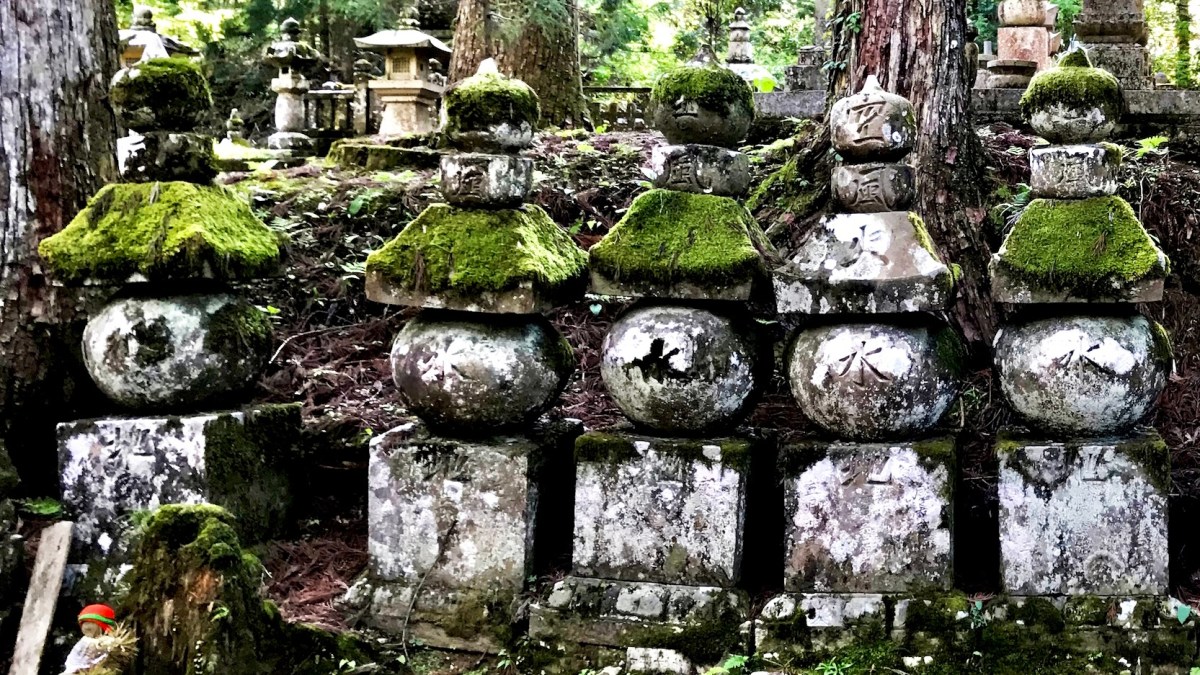
Over 200.000 moss-covered tombstones and pagodas lie peacefully slumbering among ancient cedar trees. Both historical figures and ordinary people have been laid to rest here.

While exploring Oku-no-In, the calm and serenity of the cemetery was only ever interrupted by the occasional passing pilgrim clad in white, or a few discreet visitors. The crunching of dried cedar needles beneath our feet and the rhythmic hammering of woodpeckers in the trees made up the soundscape around us.

Along the path, the dozens of statues wearing red bibs caught our attention. They are images of the bodhisattva Jizō. According to Buddhist belief, Jizō is the guardian deity of children and is meant to protect them in the afterlife. The bibs are tied around the neck of the statues by people who have lost a child. They pray to Jizō so that he may watch over them and grant long life to all living children.

The sando, the path winding through Oku-no-In for 2 kilometers, leads to the mausoleum of Kōbō Daishi (the spiritual center of Mount Kōya – this is where the monk is said to spend eternity in a permanent state of meditation), as well as to the Tōrō-dō (a temple dedicated to prayer, containing over 10 000 golden lanterns). You need to follow the sando back in the opposite direction in order to leave the cemetery.


At the end of the day, when we arrived at our temple inn run by monks, we felt as though we were floating, At the same time, we were exhausted from the intense experience we had just had. Our dinner, consisting of Shōjin-ryōri (the traditional vegetarian cuisine of Buddhist monks), and the Buddhist ceremony we attended at dawn the next morning, were enriching moments that really added to our spiritual getaway, which only ended once we arrived in Kyoto a few hours later.

Don’t miss our Travel diary from Japan
Discover more from Strafari
Subscribe to get the latest posts sent to your email.
 Strafari
28 replies on “Mount Koya, Japan: a unique atmosphere”
This is very exciting. Japan has a lot to offer aside from its beauty and scenery the culture is just amazing and wonderful. I can’t wait to visit this beautiful country very soon. Thank you for sharing!
LikeLiked by 2 people
Thank you! Japan definitely has a great many facets 😊
LikeLike
I jumped up when I saw this! Mount Koya has such a special place in my heart. It is incredibly beautiful. Thanks for sharing and taking me down memory lane!
LikeLiked by 3 people
This comment made us so happy! You understand exactly how we feel about this place. It certainly is very special.
LikeLiked by 1 person
Wow, quite some day!
LikeLiked by 3 people
It sure was!!
LikeLiked by 2 people
Oh wow, it’s absolutely beautiful! I’d love to visit and explore Japan further 🙂
LikeLiked by 3 people
I don’t think we’ll ever stop wanting to go back and explore more of Japan 🥰
LikeLiked by 1 person
Stunning photos and great post! It certainly sounds like an amazing place.
LikeLiked by 3 people
Thank you Grace! It most definitely was an incredible place. Like nowhere we’ve ever been before or since
LikeLiked by 2 people
I love how the statues have been allowed to age, while still sometimes being dressed with clothes! Thank you for making this post.
LikeLiked by 2 people
That’s such a nice thought! We agree. Certainly because they are considered to be spirits/deities
LikeLiked by 1 person
Nice post! I’ve never been to Japan. I admit I’m not as fascinated with the Asian countries as I am Europe. However, I’m always open to the possibility if it ever arises.
LikeLiked by 2 people
[…] – Oku-no-In, this vast cemetery with over 200 000 graves, located in an ancient cedar forest, has a unique atmosphere that moved us deeply and left a lasting impression. Read more about Oku-no-in here […]
LikeLiked by 1 person
[…] Mount Kōya, Japan: Travel highlight […]
LikeLike
So cool!
LikeLiked by 2 people
What an incredibly beautiful forest… amazing pictures and info! Thank you 🙂
LikeLiked by 2 people
Thank you! We’re so glad you enjoyed the article 😊
LikeLiked by 1 person
Amazing Destination Indeed!
LikeLiked by 2 people
It’s an unforgettable place 🥰
LikeLike
Welcome to Japan🇯🇵
LikeLiked by 1 person
Thank you!!
LikeLiked by 1 person
Lovely photography and informative. Enjoyed reading about your trip:
“The crunching of dried cedar needles beneath our feet and the rhythmic hammering of woodpeckers in the trees made up the soundscape around us.” ❤️ Well done. 👍
LikeLiked by 1 person
Thank you so much!! We really appreciate it 🥰
LikeLiked by 1 person
I’ve been saving your post because I was surprised that you had gone to this place that I had found so inspirational way back in 2002. I just revisited my photos of it now because my niece will be going to Japan for her honeymoon. I had to recommend it to her so I passed on your lovely post. Thanks for bringing back the memories and helping the next generation make new ones!
LikeLiked by 1 person
This means the world to us! Thank you so much, Melissa. One of our Japan trips was our honeymoon as well and Koya has not left our souls since. Wishing your niece a lifetime of happiness and an unforgettable stay in Japan
LikeLike
I love this post. Which temple inn did you spend the night in and would you recommend it?
LikeLiked by 1 person
I believe it was Souji-in temple. We had a great stay, the vegetarian dinner was exceptional and we had an unforgettable experience attending the prayer ceremony at dawn. Make sure you wrap up warm, it can get quite chilly in the morning
LikeLike